
In today's lesson, we are going to learn how understanding guitar theory can significantly enhance your musical journey, transforming you from a beginner to a seasoned pro. This guide will explore the essential aspects of guitar theory, highlighting how it can accelerate your growth and deepen your appreciation of music.
1. Understanding Music Notation
Music notation is the foundation of guitar theory, enabling you to read and interpret musical pieces accurately. Learning to read sheet music, tablature, and chord charts will:
- Enhance Communication: Allows you to communicate effectively with other musicians.
- Broaden Repertoire: Enable you to learn a wide range of music, from classical to contemporary.
- Improve Sight-Reading Skills: Develop your ability to read and play new pieces quickly.
Chord Chart

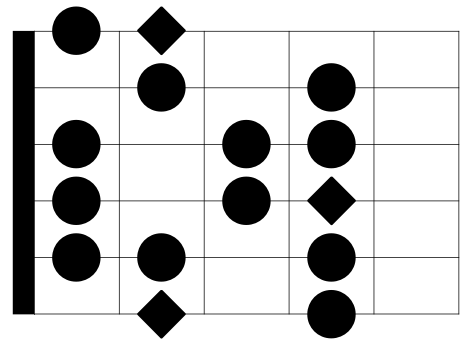
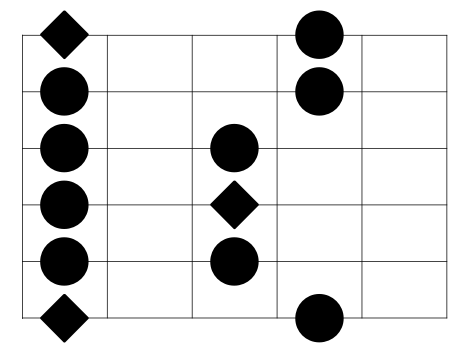
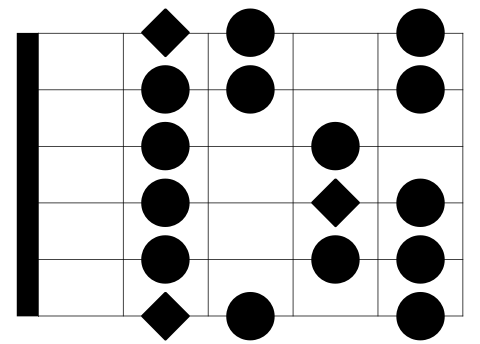
A chord chart is a diagram where the guitar is facing upward. The vertical lines represent the guitar strings, with the biggest string on the left and the smallest on the far right. The horizontal lines represent the frets. Most charts indicate a span of five frets. The thick bar at the top represents the guitar nut.
Tablature

Tablature is more like standard notation, with the guitar strings arranged horizontally. With the 6th string (low E)being on the bottom, and the 1st string (high E) being on the top. The vertical lines represent measures—sections of the music.
2. Mastering Scales and Modes
Scales and modes are the building blocks of melodies and solos. By mastering them, you can:
- Create Melodies: Develop your ability to craft engaging and emotive melodies.
- Improve Soloing: Enhance your improvisational skills and add variety to your solos.
- Understand Key Signatures: Know how different scales relate to one another to aid key changes and modulation.
The Major Scale
The Minor Pentatonic Scale
The Phrygian Mode
These are all very common scale patterns used in melody and harmony. It is recommended that you learn them and use them in your compositions, both to create rhythm and to craft guitar solos.
3. Chord Theory and Progressions
Understanding chord theory and progressions is crucial for songwriting and accompaniment. This involves:
- Chord Construction: Learn how chords are built, including major, minor, diminished, and augmented chords.
- Harmonization: Discover how to harmonize melodies using chords.
- Building Progressions: Create compelling chord progressions that form the backbone of any song.
Chords are built from the notes of the key they come from. Like, for example, the key of C major.
C Major: C D E F G A B = 1 2 3 4 5 6 7
C Major Chord Formula = 1 3 5
C Major Chord = C E G
G Major: G A B C D E F# = 1 2 3 4 5 6 7
G Major Chord Formula = 1 3 5
G Major Chord = G B D
Can you see how this works? Master the notes in the key, and you can unlock the secrets within it by knowing the notes. The notes are the keys that unlock the mystery and allow you to create with unlimited possibilities.
4. Rhythm and Timing
Rhythm and timing are essential components of music that can elevate your playing. Mastering these aspects will:
- Enhance Groove: Improve your ability to maintain a steady tempo and feel the beat.
- Syncopation Understanding: Learn to play with rhythmic variations and off-beats.
- Polyrhythms: Explore complex rhythms and integrate them into your playing.
The most common time signature is 4/4. Count 1, 2, 3, 4. But to make things interesting, you change up the timing. Possible to 3/4 time, three beats per measure. Or 7/8 time, which will be seven eighths per measure. By mastering these different timing sequences, you can create music that catches the listener at a different angle.
5. Ear Training and Aural Skills
Developing your ear is a critical aspect of guitar theory that enhances your musical intuition. Benefits include:
- Pitch Recognition: Identify pitches and intervals by ear, which aids in tuning and transcribing.
- Chord Identification: Recognize chord qualities and progressions without sheet music.
- Improvisation: Improve your ability to improvise by trusting your ear to guide your note choices.
Being able to recognize notes by ear allows you to learn and play without sheet music. Some situations might not have the written word, so you will need to be able to create without it. Create chords, rhythms, melodies, and improvisation.
All this can be done by taking time to recognize note intervals. This is the distance between notes. These can be broken down into whole steps and half steps. A whole step is two frets apart, and a half step is one fret apart.
Whole fret = 2 frets
A to B would be a whole step apart because the A# resides between them in the chromatic scale.
Half Step = 1 fret
B to C would be a half step apart because there is no note between them in the chromatic scale.
Master the musical alphabet, also known as the chromatic scale. This will help you understand note intervals and improve your ear training and improvisation for both rhythm and soloing.
6. Soloing and Improvisation
Soloing and improvisation are vital skills for any guitarist, allowing for personal expression and creativity in your music. By focusing on these areas, you can:
- Express Yourself: Use your solos as a form of personal expression, conveying emotions and stories through your playing.
- Explore Different Styles: Experiment with various musical styles and genres, incorporating unique elements into your solos.
- Develop Technical Skills: Enhance your technical abilities, including finger dexterity, speed, and precision, which are essential for executing complex solos.
- Understand Musical Context: Learn to solo in a way that complements the song's harmony and structure, making your solos feel cohesive and integrated.
- Enhance Communication: Improve your ability to interact with other musicians during jam sessions to create seamless musical conversations.
By mastering soloing and improvisation, you'll not only expand your musical toolkit but also gain the confidence to perform with individuality and flair. Integrating scales into your improvisational practice, you'll not only become more versatile as a guitarist but also more confident in your ability to create music on the fly.
By delving into these five topics, you will not only accelerate your growth as a guitarist but also gain a deeper understanding and appreciation of music. With dedication and practice, guitar theory will transform your playing, enabling you to express yourself more fully and creatively.
Dive Deeper Into Theory
If you'd like to learn more about guitar theory, I recommend you check out the books I've authored on the subject. These will help you to fully understand how guitar theory can excel your playing in these two areas.
Learn Guitar Chord Theory

This book will teach you everything you need to know about chords. This will allow you to unlock your creativity, deepen your musical understanding, and communicate with other musicians. You'll be able to pick the right chords for the right emotion that you are trying to convey in a composition, as well as analyze existing songs and enhance your musical vocabulary.
Learn Guitar Scale Theory
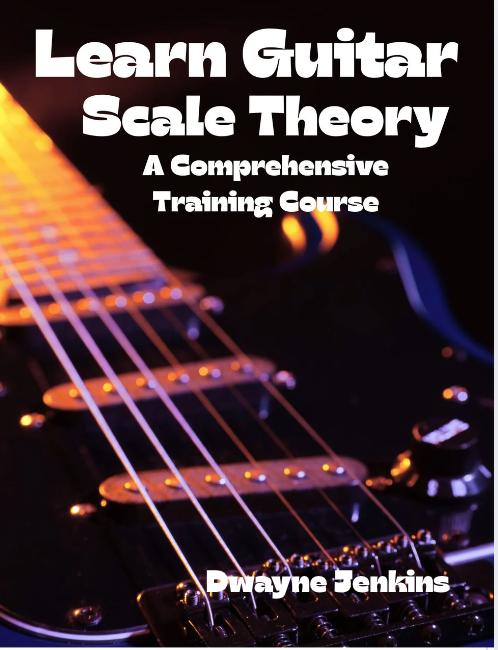
Learn guitar scale theory builds dexterity, muscle memory, and finger independence. It helps with understanding song structure and makes learning new songs easier. It enables better ear training by unlocking the power of improvisation and songwriting, transforming you as a guitarist into someone who doesn't just play notes but creates music.
Both of these books can not only help you in these areas individually, but they also complement each other. By knowing guitar theory from both perspectives, you not only enhance your knowledge of harmony and melody, but you also master the guitar fretboard.
Help Is Available If Needed
And the best part is, if you purchase one or more of my books, free email support from me is available, free of charge. If you get stuck, reach out through my website, and I'll be happy to help. With that kind of assistance, you're sure to succeed! So check out the books currently on sale and watch what you learn in them take your playing to the next level. They are published in both digital and paperback formats for your convenience.
Digital can be found on my website, and paperbacks can be found worldwide on Amazon and where all physical books are sold. Thanks for your time today. I hope you learned something. If you have any questions, feel free to reach out. Best of luck with your guitar playing, and take care.
Sincerely, Dwayne Jenkins