
In today's lesson, we are going to learn to simplify guitar chord theory for better performance. Guitar chord theory can often seem daunting for beginners and experienced players alike. However, simplifying it can significantly enhance your performance and enjoyment of playing. Let’s delve into some ways to make chord theory more approachable and efficient.
Understanding the Basics
Before diving deeper, it's essential to grasp the basic elements of chord theory:
- Notes: The building blocks of chords. Each note has a specific pitch and duration. Knowing all 12 notes to the musical alphabet or chromatic scale, as it is sometimes called, will allow you to build a solid foundation for creating harmonies and melodies.
A-A#-B-C-C#-D-D#-E-F-F#-G-G# = the 12 notes of the chromatic scale.
What is Western music made up of? Including Jazz, Rock, Blues, and Folk. Country, Etc. Know these 12 notes, and you'll understand the basics of all these types of music.
- Intervals: The distance between two notes. Intervals are crucial in forming chords and scales. Notes can be broken down into two categories: whole steps and half steps. Allowing you to determine the pitch of a note and other notes that relate to it. This works wonders when determining if chords and scales are major or minor.
A whole step = two frets. Example = A-B. These two notes are two frets apart from each other.
A half step = 1 fret. Example = B-C. These two notes are one fret apart from each other.
A Step and a half. This is a combination of the two. Example = A-C. These are three frets apart.
Mastering intervals helps you enhance your playing by ear by improving ear training, replacing memorization of notes with movable patterns. This helps to enhance songwriting and facilitates clear communication with other musicians.
- Scales: A sequence of notes in a specific order. Major and minor scales are the foundation of chord construction.
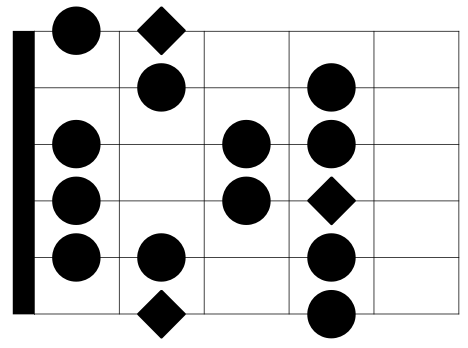
Major Scale Pattern: 1 2 3 4 5 6 7
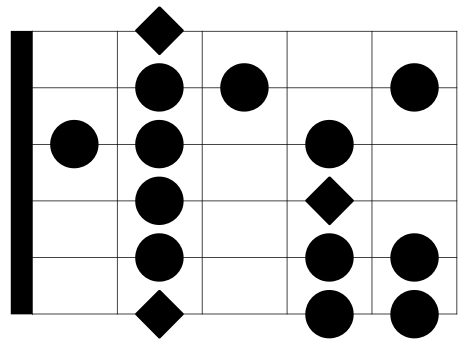
Minor Scale Pattern: 1 2 b3 4 5 b6 b7
By familiarizing yourself with these patterns and their note intervals, you'll develop a strong foundation for understanding music theory and how to craft solos, melody lines, and chords.
Focus on Triads
Triads are the simplest type of chord, consisting of three notes: the root, third, and fifth. They form the basis of most chords you’ll encounter. Here’s how you can break them down:
- Root: The starting note of the chord.
- Third: This note determines the chord’s quality—major or minor.
- Fifth: Completes the triad, providing fullness.
Chord Example: C Major = C D E F G A B
C Major Chord = 1 3 5 = C E G
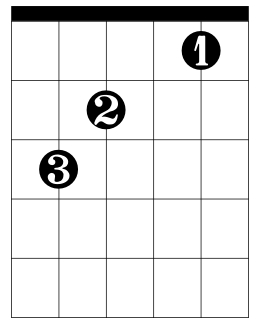
To make a minor chord, you flatten the 3rd note by a half step or one fret. This concept works on all major triads. Once you get this down, you can create augmented triads by sharpening the 5th note by one fret and diminished chords by flattening the 3rd and 5th notes by one fret.
C Minor Chord = 1 b3 5 = C Eb G
C Augmented = 1 3 #5 = C E G#
C Diminished = 1 b3 b5 = C Eb Gb
This concept allows you to create not only additional chord types but also other emotional tones. That's the name of the game: to create a variety of emotions that you can use in your music to captivate the listener.
By mastering triads, major, minor, augmented, and suspended, you build a solid foundation of chord theory and a solid vocabulary of guitar chords that you can extend and build on to enhance your musical landscapes.
Master the Circle of Fifths
The Circle of Fifths is an invaluable tool for understanding chord relationships. It helps you see how different keys are related and how chords transition smoothly. Here’s how to use it:
- Recognize key signatures and their relative minors.
- Understand which chords naturally fit together in a progression.
- Use it to transpose songs into different keys easily.
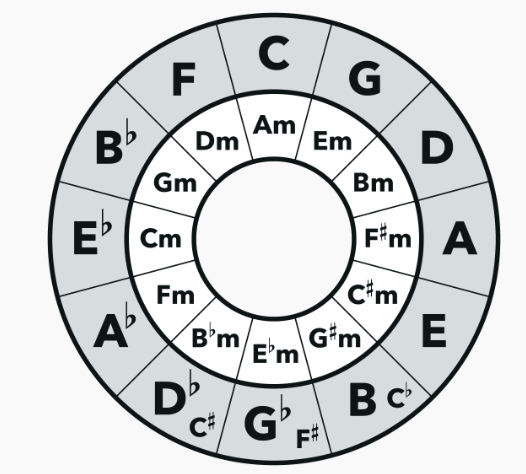
This visualization not only aids in learning but also enhances your ability to create harmonious music. Remember, the outer keys move forward in 5ths. G is the 5th of C, D is the 5th of G, A is the 5th of D, and so forth. The inner letters indicate the notes that are sharpened or flattened within that key.
For example, the C has no sharps or flats, which is why it's at the top. The following key is G, with one sharp: F#. The following key is D, with two sharps. The next one is A with three, and so forth. Master this chart, develop a complete understanding of it, and you'll be ahead of 99% of guitarists.
Embrace Chord Families
Chord families, or harmonized scales, are groups of chords that sound good together. By learning these families, you can quickly identify which chords work well in a particular key:
- Prominent Chord Family: Consists of the I, IV, and V chords.
- Minor Chord Family: Includes the ii, iii, and vi chords.
Chords within a key example: CM, Dm, Em, FM, GM, Am, and B will be diminished.
Knowing these chord families enables you to create smoother chord transitions by knowing which ones work within a key. By knowing which ones are major and which ones are minor, you can control the emotional value of chord progressions.
Practice with Common Progressions
Certain chord progressions are used in countless songs across genres. Familiarizing yourself with these can significantly improve your performance capabilities:
- I-IV-V: A staple in rock, blues, and pop.
- Ii-V-I: Popular in jazz.
- Vi-IV-I-V: Known as the "pop-punk progression."
A I-IV-V Progression Example: G C D
Practicing these progressions will not only make you a more versatile player but also improve your improvisational skills. These concepts and practices can also enhance your songwriting abilities.
Use Visual Aids
Visual aids such as chord charts and diagrams can simplify complex theory. They provide an easy reference and help reinforce your learning. Here’s how they can be beneficial:
- Chord Charts: Display finger positions for various chords.
- Diagrams: Show the relationship between notes and chords on the fretboard.
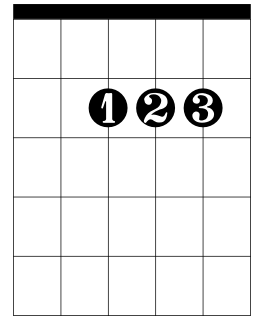
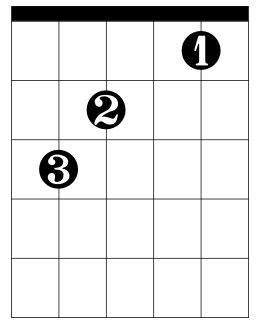
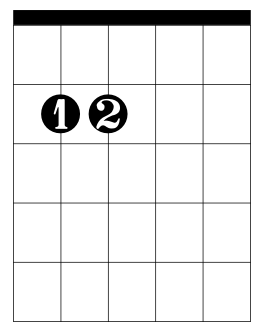
These resources are invaluable for visual learners, making abstract concepts more concrete. Studying sheet music daily will enhance your eye-hand coordination. There is a distinct difference between perceiving music by ear and perceiving music by sight. By developing the skills to do both, you will increase your overall musicianship.
Continuous Practice and Application
Finally, the key to mastering guitar chord theory is consistent practice and application. Here are some tips:
- Dedicate regular time to practice scales and chord progressions.
- Apply your knowledge by learning new songs.
- Experiment with composing your own progressions.
By continuously applying what you learn, you’ll find that theory becomes second nature, and your performance will reflect your growing understanding.
By simplifying guitar chord theory, you can enhance your musical journey, making it more enjoyable and fulfilling. With these strategies, you’ll be well on your way to becoming a more confident and skilled guitarist.
Unlock Musical Mastery
To learn more about how guitar chord theory can enhance your guitar playing, I recommend you check out the book I authored, Learn Guitar Chord Theory.

Guitar chord theory is not just for advanced musicians or those studying music academically. Whether you're a beginner or an experienced player, understanding the theory behind chords can significantly enhance your guitar playing skills. Here are some key benefits:
- Foundation of Music: Guitar chord theory provides a solid foundation in music theory, helping players understand how music is structured.
- Comprehension of Chord Progressions: It helps explain why certain chords sound good together, making it easier to compose and improvise.
Learning guitar chord theory opens the door to a deeper understanding of music, enhancing creativity and versatility across genres. By mastering this fundamental skill, guitarists can communicate effectively with fellow musicians and elevate their playing to new heights. Embrace the power of chord theory to unlock your full potential as a musician.
So, if you're serious about taking your guitar playing and musicianship to the next level, grab the book and start with step one. Before you know it, you'll open up a whole new world of musical wonder. I hope you learned something here today, and good luck with your studies. If you need any help, feel free to contact me at my website.
Sincerely, Dwayne Jenkins