
Another fun instrument to learn to play is the ukulele. It is very similar to the guitar, but a bit different. This is a great instrument to get started with because of its ease of playability. In today's lesson, we'll learn how to unlock melodies. A step-by-step guide to playing the ukulele.
Playing the ukulele is a delightful journey into the world of music, offering a unique blend of simplicity and joy. This guide will walk you through the essential steps to master this charming instrument, ensuring you unlock the melodies that bring the ukulele to life.
Understanding the Basics
Before diving into playing, it's crucial to familiarize yourself with the ukulele's components and how they contribute to its unique sound.
Parts of the Ukulele

- Body: The hollow section that amplifies the vibration of the strings. This is how the sound is created.
- Neck: The elongated part connecting the body to the headstock, where you'll find the fretboard. This is the part of the instrument that you will hold to form chords.
- Fretboard: Located on the neck, containing frets that help change the pitch of the strings. This is the part of the ukulele where you will form chords and play scales.
- Strings: Typically four strings tuned to G, C, E, and A. These are nylon and produce a tuning structure that makes it easy to form chords.
- Tuning Pegs: Located on the headstock, they hold the strings to the neck and are used to tighten or loosen them.
- Bridge: This is where the strings anchor to the body of the instrument and efficiently transfer string vibration, also part of the instrument, where you can create a percussive sound with palm muting.
Selecting Your Ukulele
Choosing the right ukulele can significantly impact your playing experience. As we know, the wrong one can make it frustrating to learn and make you not want to practice. So make sure to pick the right one that works for you.
There are four main types to consider:
- Soprano: The smallest and most traditional size, offering a bright and light sound.
- Concert: Slightly larger than the soprano, providing a fuller sound.
- Tenor: Offers a deeper tone and is often preferred by professional players.
- Baritone: The largest size, with a sound similar to a classical guitar.
The soprano ukulele is the most popular one. The one that is usually associated with playing the ukulele. Since it is the smallest, it is recommended that you start with this one.

Tuning Your Ukulele

Proper tuning is essential for creating harmonious melodies, training your ear, enabling you to play with others, and achieving the instrument's bright, cheerful sound. By setting the right pitch for each string, you allow the chords to sound out as they should. This keeps the music and practice sessions more pleasant.
The standard tuning for a ukulele is G-C-E-A. Here's how you can tune your ukulele:
- Use a Tuner: Electronic tuners are highly recommended for beginners. These are widely available and easy to use. An App is also a great option.
- Tune by Ear: Once you're comfortable, you can learn to tune by ear using reference notes or other instruments. This is a more advanced way to do it, but the benefit is that it helps train your ear to hear notes.
Work on using a tuner first, and then once you get that down, work on tuning by ear. This will not only improve your ear training but also your musicianship.
Basic Chords and Strumming Patterns
Learning a few basic chords will enable you to play a multitude of songs. What is excellent about the ukulele is that some of the chords only require one or two fingers, making it an ideal instrument to get started and progress quickly.
Reading Chord Charts

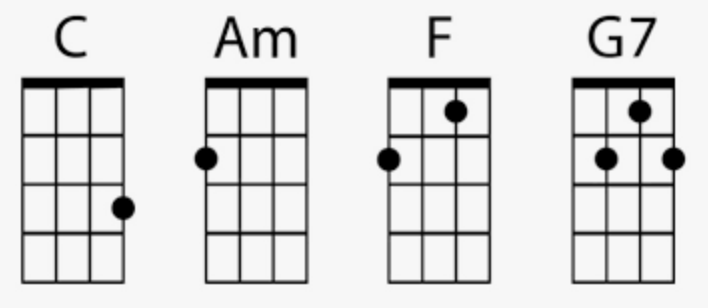
As you can see from the diagram, the strings are labeled with the G string to the far left and the A string to the far right. The vertical lines represent the strings, and the horizontal lines represent the frets. This is important to know when reading chord charts and learning the best finger positions to form ukulele chords.
Essential Chords
- C Major: Place your ring finger on the third fret of the A string.
- A Minor: Use your index finger on the second fret of the G string.
- F Major: Position your index finger on the first fret of the E string and your middle finger on the second fret of the G string.
- G Seven: Place your index finger on the second fret of the C string, the middle finger on the first fret on the E string, and the ring finger on the second fret of the A string.
These four chords are a great place to start your ukulele chord vocabulary. They are all reasonably easy to play, and you can start with one finger, then two, and eventually progress to three. By doing it this way, you avoid strin by building dexterity in your fingers and memory in your muscles.
Eventually, you learn to string these together to form chord progressions, which are the foundation of many songs. You first learn to form the chords, then you know how to switch between them, and then form them into a sequence that can be repeated to create rhythm.
Strumming Patterns
Experiment with different strumming patterns to add rhythm to your playing:
- Down Strum: The most basic strumming pattern. You strum down on every beat.
- Down-Up Strum: The second most basic strumming pattern, using a down and up motion.
- Island Strum: Down, down-up, up, down-up.
Down Strum:
D-D-D-D | D-D-D-D | D-D-D-D | D-D-D-D |
Down Up Strum:
D-U-D-U | D-U-D-U | D-U-D-U | D-U-D-U |
Island Strum:
D-DU-U-DU | D-DU-U-DU | D-DU-U-DU | D-DU-U-DU |
Use these two strum patterns as a foundation. I recommend you start with strumming down on all beats first, then progress to the down-up strum. Once you have them down, work on the Island strum. Listen for the different rhythms that these strum patterns create.
Work on developing your picking hand, as well as your fretboard hand. The picking hand creates the rhythm, and the fretboard hand forms the chords and makes the progression. These two hands must work in unison to create the beautiful music heard when one plays the ukulele.
Practicing Songs
Choose simple songs to practice your newfound skills. Start with familiar tunes that use the chords you've learned, allowing you to focus on rhythm and strumming.
Enhancing Your Skills
As you become more comfortable, you can explore advanced techniques:
- Fingerpicking: Plucking individual strings for a more intricate sound.
- Chord Progressions: Understanding common progressions can help you learn new songs faster.
- Improvisation: Experiment with creating your own melodies and rhythms.
Dive Deeper into the Ukulele.
If you're interested in learning more about the ukulele, check out the book I authored that can help you excel in your learning. Learn To Play The Ukulele.

Unlocking harmony and melodies on the ukulele is a rewarding and accessible way to explore the world of music. With daily practice, patience, and determination, you'll find yourself strumming along to your favorite tunes and creating your own. With pictures, diagrams, easy-to-read notation, and step-by-step instructions, you'll embrace the journey and let the music guide you. Available in both digital and paperback versions on Amazon and in all bookstores.
Thanks for your time today, and best of luck with your learning.
Sincerely, Dwayne Jenkins
Dwayn'e Guitar Lessons.